The Nalanda Tradition
A living tradition of wisdom, compassion, meditation, and inner transformation rooted in the ancient Nalanda lineage.
Tibetan Buddhism is a living tradition of wisdom, compassion, meditation, and inner transformation that traces its origins directly to the teachings of the Buddha over 2,500 years ago.
More than a religion alone, Tibetan Buddhism represents a complete path of spiritual development—one that emphasizes ethical living, compassion for all beings, philosophical inquiry, contemplative practice, and the cultivation of wisdom.
While Tibetan Buddhism flourished in Tibet and the Himalayan regions, its roots lie in the great Buddhist universities of ancient India. For this reason, Tibetan Buddhism is often described as one of the most complete surviving preservations of the Nalanda Buddhist tradition.
Today, this lineage continues to be studied and practiced throughout the world.
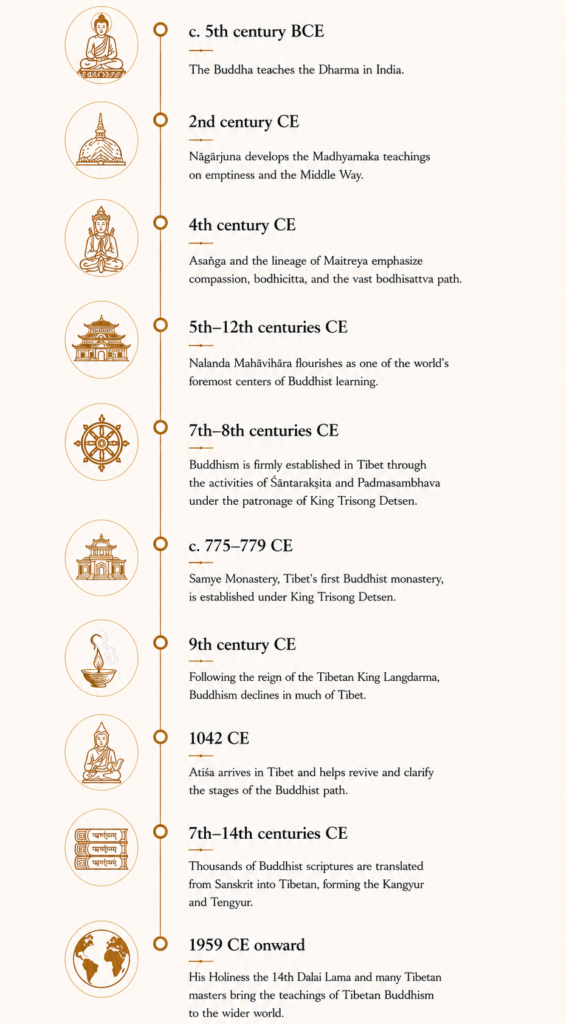
The foundation of Tibetan Buddhism begins with the teachings of Śākyamuni Buddha, who taught a path leading to freedom from suffering through ethical conduct, meditation, and wisdom.
Following the Buddha’s passing, generations of scholars, meditators, and practitioners carefully preserved and transmitted these teachings throughout India.
Over many centuries, Buddhism developed into a rich and sophisticated tradition encompassing philosophy, psychology, ethics, contemplative practice, and spiritual realization.



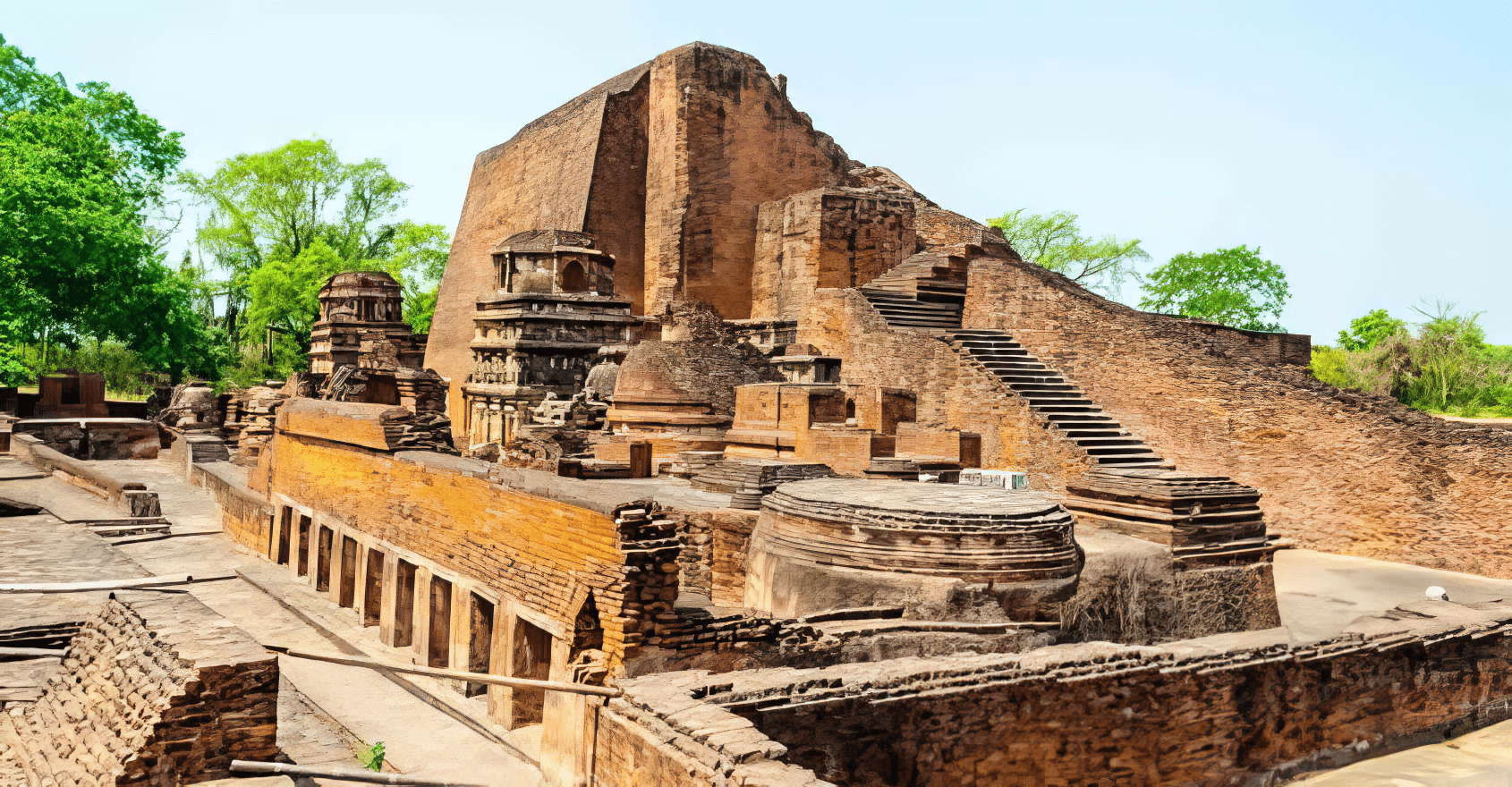
For nearly seven centuries, Nalanda Mahāvihāra (c. 5th–12th centuries CE) in northern India stood among the world’s foremost centers of learning.
Thousands of monks and scholars gathered there to study philosophy, logic, meditation, ethics, medicine, and the sciences of the mind. Students traveled from across Asia to receive instruction from some of the greatest Buddhist masters in history.
Nalanda became the intellectual and spiritual heart of Indian Buddhism, and its traditions would later become the foundation of Tibetan Buddhism.
Its influence extended far beyond India and played a central role in shaping the Buddhist traditions that spread throughout Asia, including Tibet.


Tibetan Buddhism preserves the teachings of many of India’s greatest Buddhist masters, often collectively known as the Seventeen Great Scholars of Nalanda.
These masters include such renowned figures as Nāgārjuna, Āryadeva, Asaṅga, Vasubandhu, Dignāga, Dharmakīrti, Candrakīrti, Śāntideva, and others whose writings continue to be studied today.
The writings of these masters form the core curriculum studied in Tibetan monasteries to this day. Monastic scholars continue to engage in rigorous study, debate, contemplation, and meditation based upon these classical works.
The preservation of these teachings is one of the defining characteristics of Tibetan Buddhism and one of the reasons it is regarded as a living continuation of the Nalanda tradition.
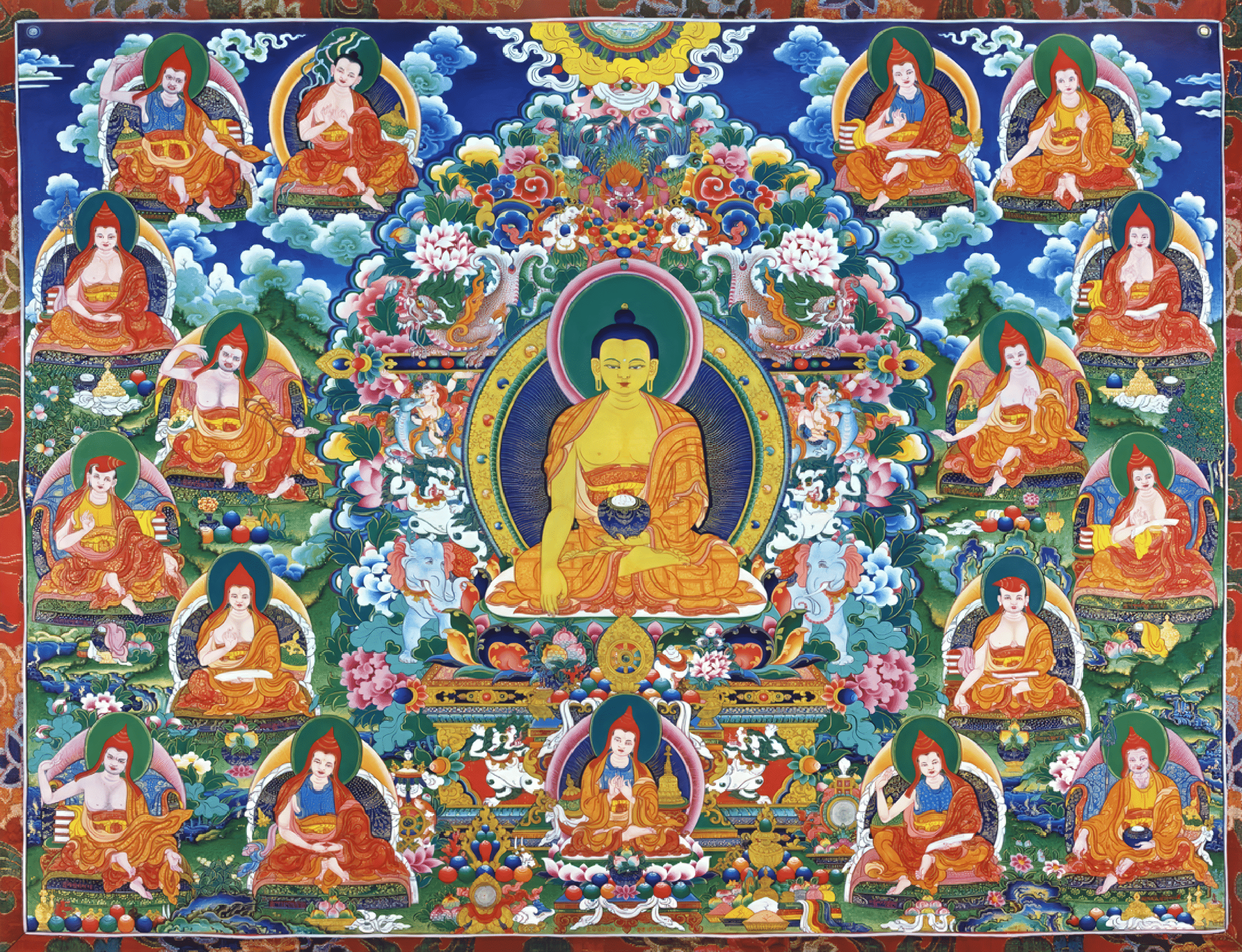
Shakyamuni Buddha and the 17 Nalanda panditas. Image courtesy of the Office of His Holiness the Dalai Lama.
Among the great masters of Nalanda, two figures exerted especially profound influence on Tibetan Buddhism.
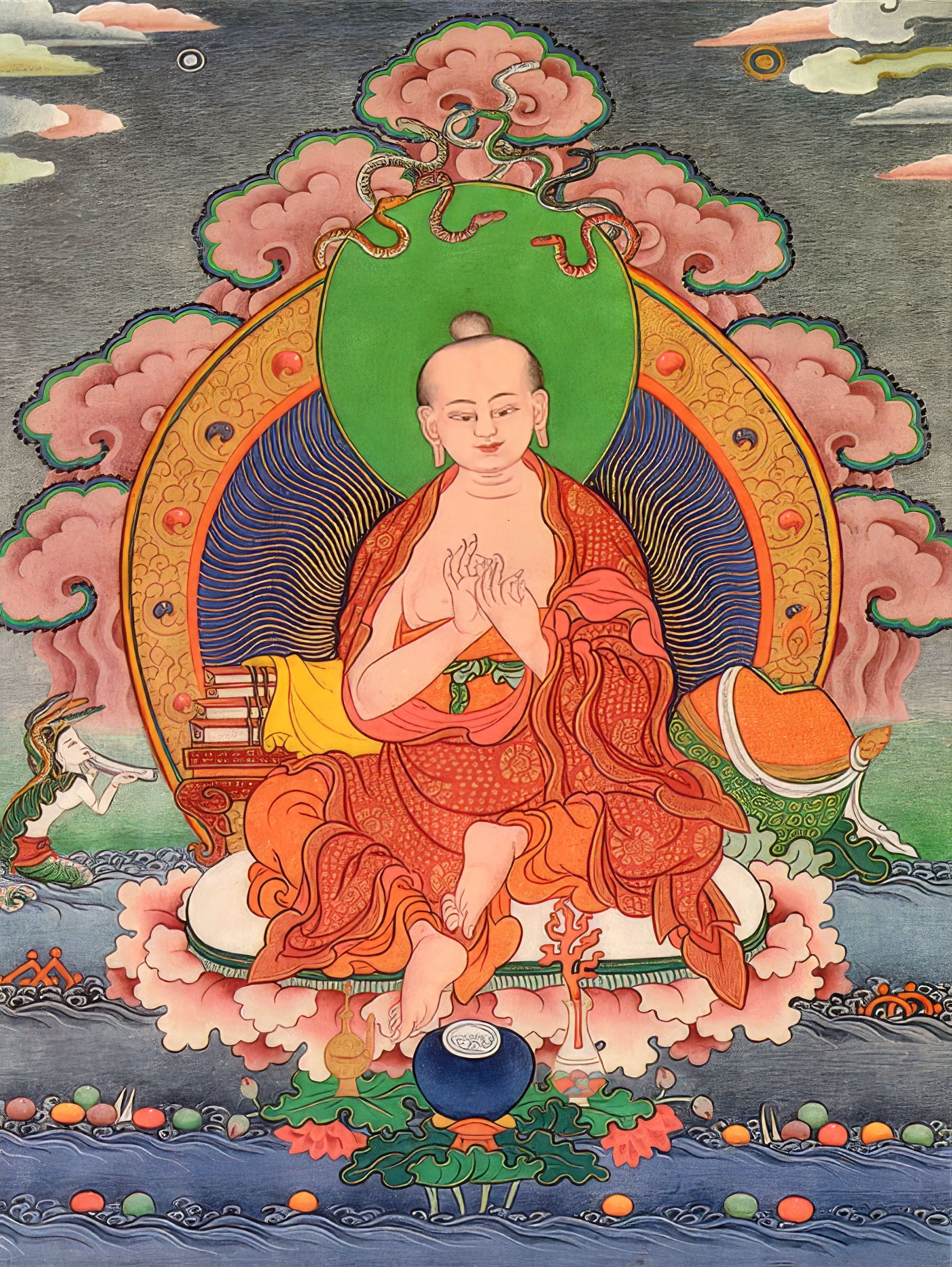
Nāgārjuna (c. 2nd century CE), traditionally associated with the wisdom lineage of Manjushri, articulated the Madhyamaka, or Middle Way, philosophy.
His teachings examine the nature of reality and emptiness, forming the philosophical foundation of much of Tibetan Buddhist thought.
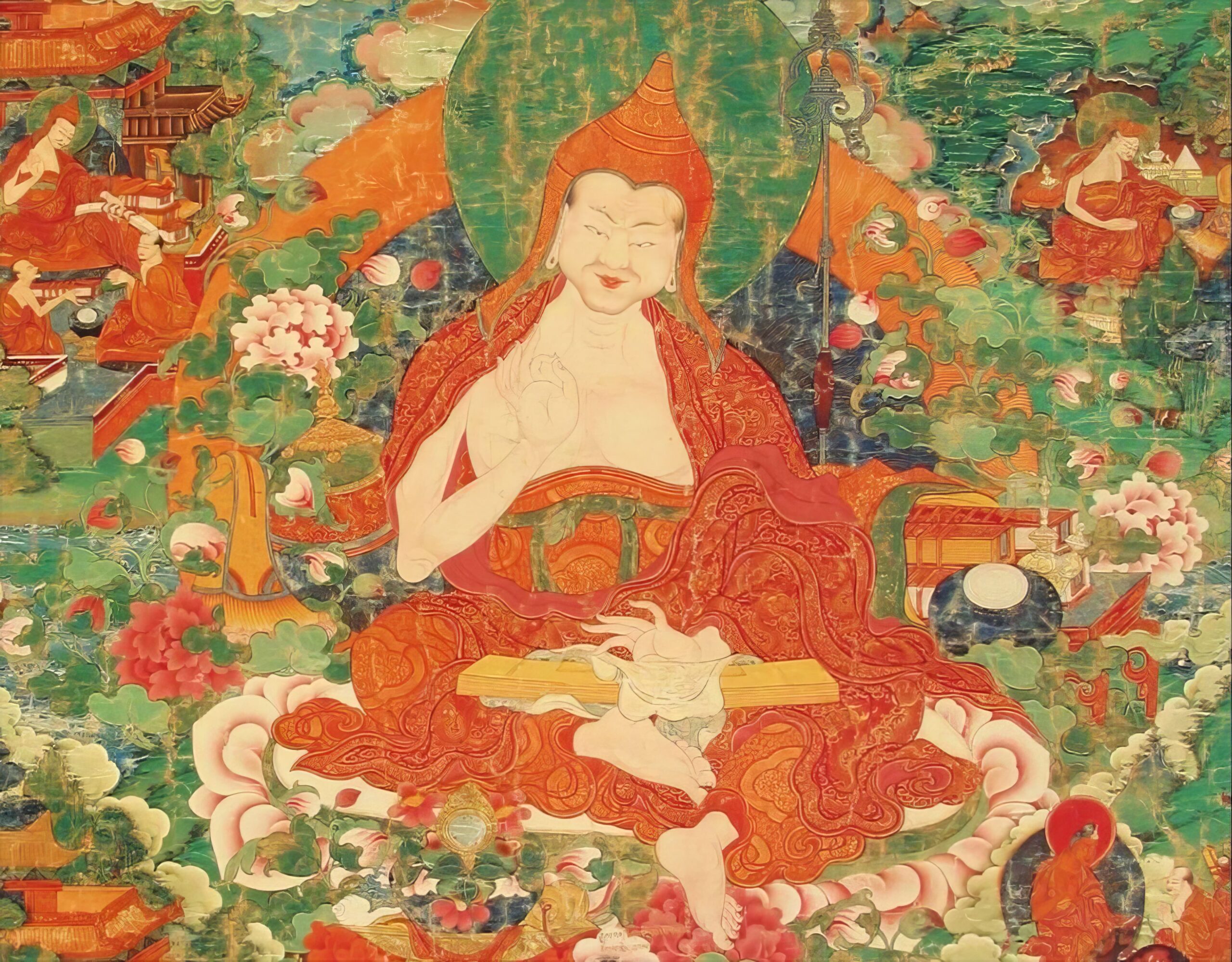
Asaṅga (c. 4th century CE), drawing upon the lineage of Maitreya, emphasized compassion, bodhicitta, and the activities of the bodhisattva dedicated to the welfare of all beings.
Together, these traditions became known in Tibet as the union of the Profound View and the Vast Conduct—a synthesis that remains central to Tibetan Buddhist study and practice today.
Beginning in the seventh century, Tibetan kings invited great Buddhist masters from India to Tibet.
Among the most influential were Śāntarakṣita (c. 725–788 CE), Padmasambhava (8th century CE), and later Atiśa (982–1054 CE). Working alongside Tibetan translators and practitioners, they established monasteries, translated scriptures, and laid the foundations for the flourishing of Buddhism in Tibet.
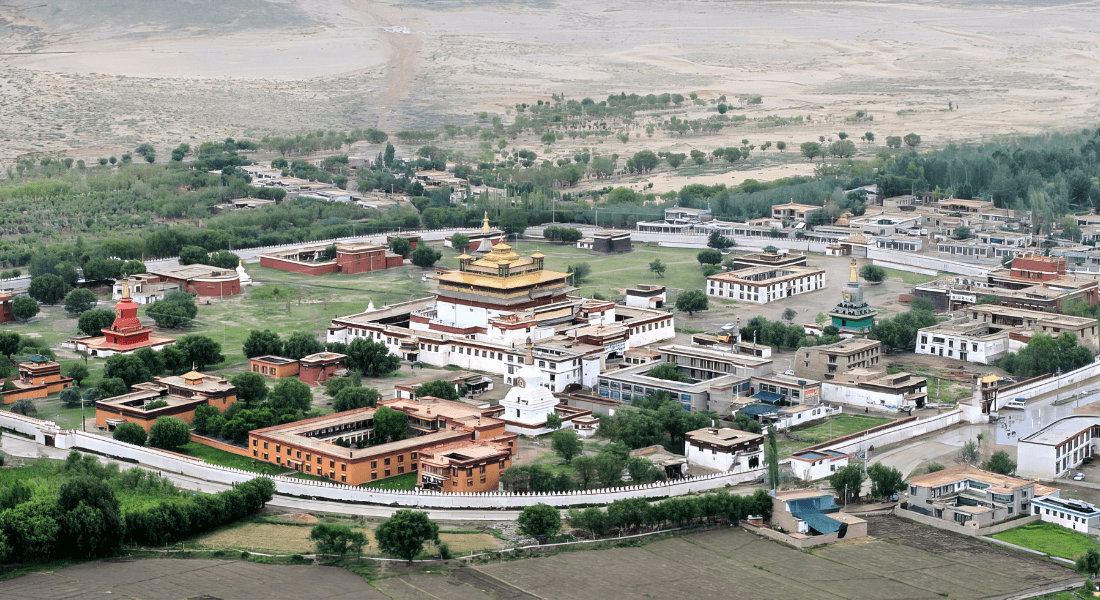
A major milestone was the founding of Samye Monastery (c. 775–779 CE), traditionally regarded as Tibet’s first Buddhist monastery. Established under the patronage of King Trisong Detsen, Samye became a center of translation, monastic education, meditation, and philosophical study, helping establish the Buddhist tradition in Tibet for centuries to come.
Over time, Tibetan Buddhism came to preserve and integrate the rich philosophical traditions associated with Nāgārjuna, Asaṅga, and the great scholars of Nalanda, creating a uniquely comprehensive system of study and practice.
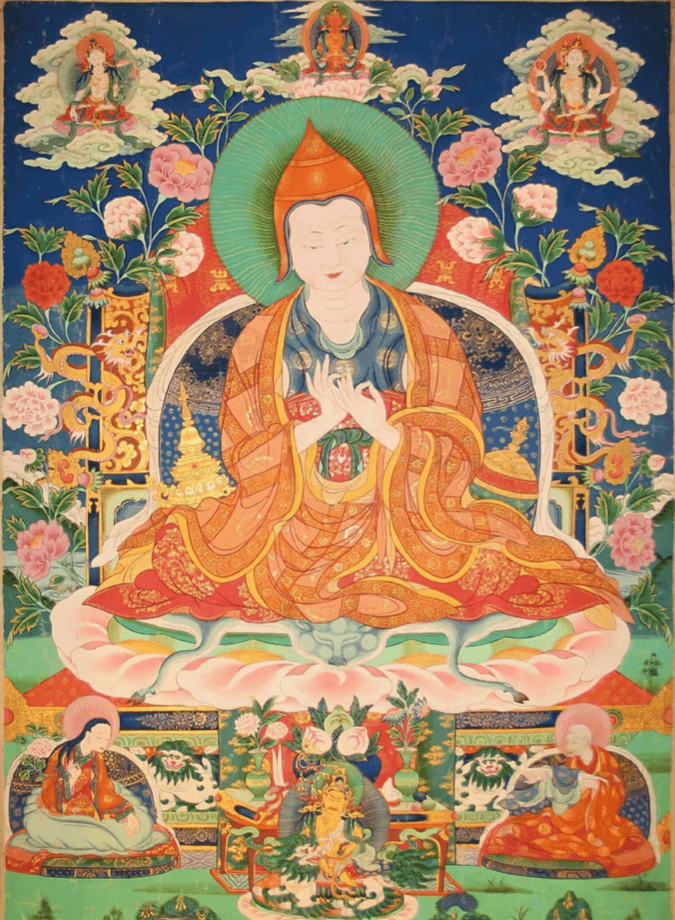
Founded in the 8th century by King Trisong Detsen, with the guidance of Padmasambhava and Śāntarakṣita, Samye is the first Buddhist monastery in Tibet.
Its design embodies the mandala of the cosmos, uniting Indian, Tibetan, and Chinese architectural traditions—a sacred symbol of the Dharma flourishing in a new land.
Following a period of political turmoil and the decline of Buddhist institutions after the reign of the Tibetan King Langdarma, many aspects of the teachings became fragmented or difficult to access.
In 1042 CE, Atiśa Dīpaṅkara Śrījñāna, a great Buddhist master from Vikrampur in present-day Bangladesh, was invited to Tibet.
Through his teachings on ethics, bodhicitta, and the gradual stages of the path to enlightenment, Atiśa helped restore clarity and unity to the Buddhist tradition.
His teachings profoundly influenced all later schools of Tibetan Buddhism and laid important foundations for the Lamrim, or “Stages of the Path,” tradition that continues to guide practitioners today.
Beginning in the seventh century CE, Tibetan kings initiated one of the most extraordinary translation and preservation efforts in religious history.
Working together, Indian paṇḍitas and Tibetan translators carefully translated thousands of Buddhist scriptures from Sanskrit into Tibetan. Great emphasis was placed on accuracy and fidelity to the original teachings.
According to Tibet an historical tradition, translation work was often carried out jointly by an Indian master and a Tibetan lotsāwa (translator), helping ensure that both the meaning and language of the teachings were transmitted correctly and consistently.
Many translated texts still preserve the names of both the Indian scholar and Tibetan translator in the colophon at the end of the scripture—a reflection of the deep care and responsibility with which these teachings were preserved.
Over time, these translations became the foundation of the Tibetan Buddhist canon, traditionally divided into two great collections:
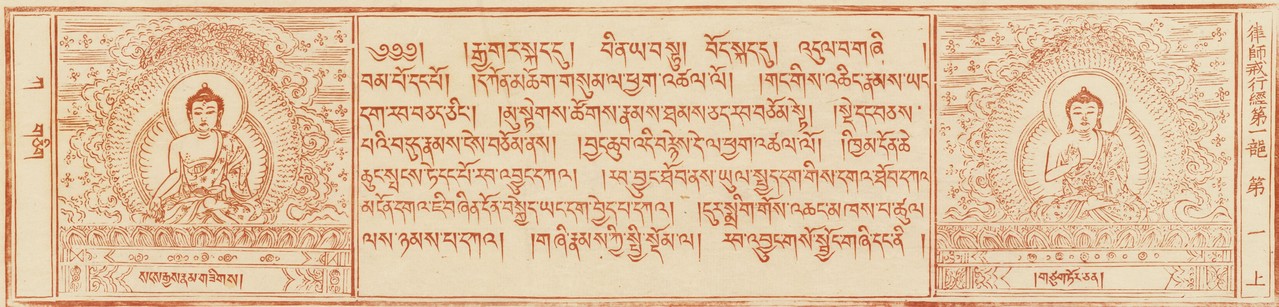
A folio from the Jiang Kangyur. Image courtesy of adarshah.org
The Kangyur, meaning “Translated Words,” contains teachings regarded as the spoken words of the Buddha, including sutras and tantras.
Depending on the edition, the Kangyur consists of roughly one hundred volumes containing more than one thousand individual texts translated into Tibetan.
The Tengyur, meaning “Translated Treatises,” contains commentaries and scholarly works composed by great Indian Buddhist masters explaining and clarifying the Buddha’s teachings.
The Tengyur is even larger, consisting of roughly two hundred volumes of philosophical treatises, commentaries, logic, psychology, medicine, ethics, and spiritual instruction.
Together, the Kangyur and Tengyur preserve one of the most extensive collections of Buddhist literature in the world.
Over the centuries, several major editions of the Kangyur were produced in Tibet and surrounding Himalayan regions, each representing enormous efforts of scholarship, printing, preservation, and devotion.
Among these are renowned editions such as the Derge, Narthang, and Beijing Kangyurs, as well as more rare regional editions preserved by particular monasteries and lineages.
One such rare tradition is the Ragya Kangyur, connected to the historic Ragya Monastery in Amdo, Tibet. Preserving and honoring this lineage remains an important part of the heritage of Ragya Mahayana Buddhist Cultural Center today.

Dege Tengyur. Image courtesy of adarshah.org
Over time, many original Sanskrit Buddhist manuscripts were lost due to war, destruction, and the decline of India’s great monastic universities.
Because of the extraordinary efforts of Indian scholars and Tibetan translators, however, these teachings were preserved in Tibetan with remarkable care and precision.
For this reason, Tibetan Buddhism is regarded today as one of the most complete surviving preservations of the ancient Nalanda Buddhist tradition. Through the Tibetan canon, countless teachings that may otherwise have disappeared continue to remain available for study and practice today.
This unbroken lineage of study, contemplation, and meditation continues to be transmitted from teacher to student across generations up to the present day.
Following the events of 1959, many Tibetan teachers left Tibet and established monasteries, centers of learning, and communities throughout the world.
Among the most influential figures in this transmission has been His Holiness the 14th Dalai Lama, whose teachings on compassion, nonviolence, interfaith dialogue, and universal human values have introduced millions of people to the wisdom of the Tibetan Buddhist tradition.
Through the efforts of His Holiness and countless teachers from all Tibetan traditions, the Nalanda lineage is now studied and practiced across Asia, Europe, the Americas, and beyond.
His Holiness the 14th Dalai Lama has consistently emphasized the importance of the Nalanda tradition—a tradition grounded in reason, compassion, and personal inquiry.
Today, Tibetan Buddhism is practiced throughout the world, preserving the wisdom of the Buddha while remaining deeply relevant to modern life.
Ragya monastery (ra rgya, pronounced Rajia in the Amdo dialect), is the second-largest Buddhist monastery in Qinghai, with over 500 monks.
This website is maintained by students of H.E. the 11th Shingza Rinpoche. Any inaccuracies or omissions are solely our responsibility.
© 2026 Ragya Mahayana Buddhist Cultural Center. RMBCC is a 501(c)(3) nonprofit organization based in Virginia.